

Key Takeaways
- Preventive maintenance fails when the wrong trigger is used. Discover how leading manufacturers balance shot-count and time-based injection mould maintenance schedules to avoid hidden wear, corrosion, and unexpected downtime.
- A mould maintenance log is more than documentation. Learn how PM records, wear measurements, and part quality samples become the backbone of mould lifecycle management and predictive decision-making.
- Even strong mould preventive maintenance programmes have limits. Explore the warning signs that indicate when preventive maintenance injection moulding is no longer enough and corrective intervention becomes unavoidable.
A mould preventive maintenance programme is only effective when it combines the right service triggers, disciplined documentation, and timely corrective action. Many mould failures do not happen because maintenance was ignored entirely, they happen because PM intervals were poorly defined, wear trends were undocumented, or early warning signs were missed until production instability became unavoidable.
This guide explores how modern manufacturers structure preventive maintenance injection moulding programmes using shot-count and time-based triggers, build traceable mould maintenance logs, and use documentation to strengthen long-term mould lifecycle management. It also examines where preventive maintenance reaches its limits, and when corrective intervention becomes necessary to restore tooling performance before quality, uptime, and delivery commitments are affected.
Drawing on EIPL’s experience across high-volume global mould programmes, the blog outlines practical strategies for building scalable injection mould maintenance schedules, improving mould storage best practices, and creating a mould maintenance plan that protects both tooling assets and production continuity.
Shot-Count vs. Time-Based PM: Choosing the Right Trigger for Your Programme
Preventive maintenance can be scheduled by elapsed time or by production usage, typically measured in shot count. Choosing the correct trigger is critical because mould wear is driven primarily by how much work the tool performs, not simply how long it exists.
Shot-count–based PM is ideal for high-volume, continuous production tools.
- Best suited for 24/7 operation or automated lines
- Maintenance intervals align directly with wear accumulation
- Prevents overuse of high-cavitation tools between calendar checkpoints
- Particularly important for abrasive materials or tight-tolerance parts
Time-based PM is more appropriate for intermittent or seasonal programmes.
- Suitable for tools that run irregularly or remain idle for long periods
- Addresses corrosion, lubrication breakdown, and environmental effects
- Ensures dormant moulds do not deteriorate unnoticed
EIPL recommendation: use whichever interval is reached first. A mould that hits its shot threshold early should be serviced even if the calendar interval has not elapsed, and vice versa. Always treat the mould maker’s maintenance manual as the baseline authority, then refine intervals based on real operating data.
High-Volume Continuous Tools: Shot-Count-Based PM
Shot-count–based PM is best suited for high-volume mould preventive maintenance programmes where tools run continuously or on automated production lines. Since mould wear is driven primarily by production cycles rather than calendar time, shot-count tracking aligns maintenance directly with actual tool usage.
This approach is especially important for:
- High-cavitation tools
- Abrasive or glass-filled materials
- Tight-tolerance production programmes
- 24/7 manufacturing environments
An effective injection mould maintenance schedule based on shot count helps prevent excessive wear between service intervals and improves long-term mould lifecycle management.
Seasonal or Low-Volume Tools: Time-Based PM
Time-based PM is more appropriate for moulds that run intermittently, seasonally, or remain idle for extended periods. Even without high shot counts, moulds can still deteriorate through corrosion, lubrication breakdown, contamination, or environmental exposure.
Time-based preventive maintenance injection moulding programmes help:
- Protect idle tooling from hidden deterioration
- Maintain lubrication and corrosion control
- Ensure mould storage best practices are followed
- Keep seasonal tools production-ready
For low-utilisation programmes, calendar-based servicing often provides better protection than waiting for shot-count thresholds alone.
EIPL’s Recommendation: Use the Interval That Comes First
EIPL recommends using whichever preventive maintenance trigger is reached first, shot count or elapsed time.
For example:
- A high-volume tool reaching its shot threshold early should be serviced immediately, even if the calendar interval has not elapsed.
- A low-volume mould sitting idle beyond its scheduled maintenance window should still undergo PM, regardless of shot count.
This dual-trigger approach creates a more reliable mould maintenance plan by accounting for both production wear and environmental deterioration. EIPL also recommends treating the mould maker’s maintenance manual as the baseline reference, then refining PM intervals using real production and wear data.
Documenting Your PM Programme: The Foundation of Mould Lifecycle Management
A preventive maintenance programme without documentation quickly becomes inconsistent, untraceable, and difficult to improve. High-performing organisations treat documentation as an operational discipline, not administrative overhead.
At minimum, each mould should have a dedicated maintenance record containing:
- Maintenance log entries
Date, activity performed, technician name, observations, and any corrective actions taken - Shot counter history
Tracks actual usage and validates whether PM triggers were followed - Wear measurements for critical components
Periodic measurements of pins, bushings, cavities, and parting surfaces reveal gradual degradation trends - Pre- and post-PM part samples
Physical evidence that maintenance restored or preserved part quality
EIPL’s mould lifecycle management philosophy treats this documentation as the mould’s “medical record.” It supports predictive decision-making, justifies refurbishment timing, protects warranty claims, and provides objective data for asset valuation at end of life. Without reliable records, maintenance becomes reactive guesswork.
The Maintenance Log: Your Mould’s Medical Record
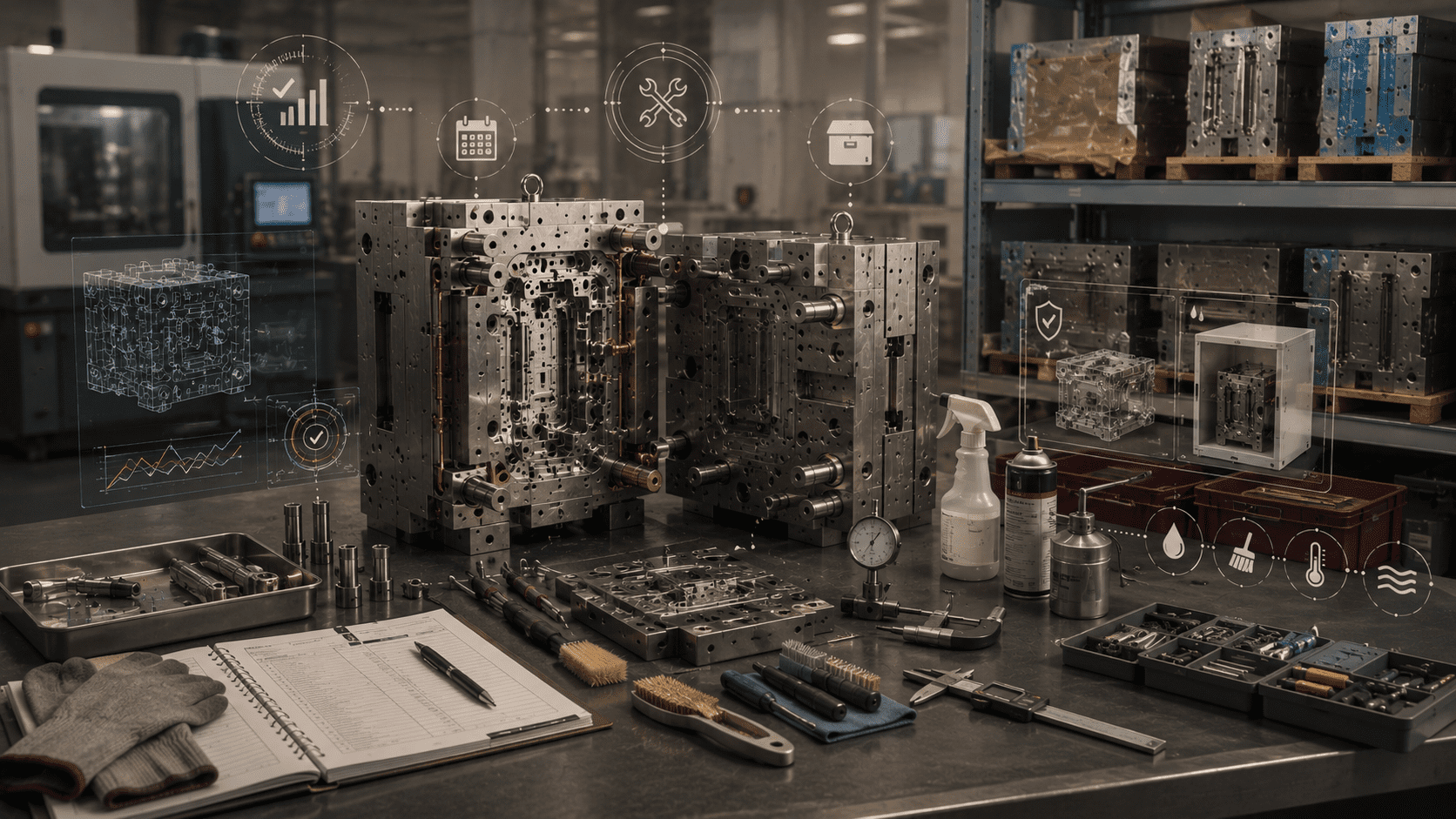
A mould preventive maintenance programme is only as reliable as its documentation. The maintenance log serves as the mould’s “medical record,” creating a traceable history of servicing, inspections, observations, and corrective actions across the tool’s lifecycle.
A strong mould maintenance log should capture:
- Date of service and PM activity performed
- Technician details and observations
- Detected wear, defects, or abnormalities
- Corrective actions and replaced components
- Follow-up recommendations or monitoring requirements
Within mould lifecycle management, this documentation supports predictive maintenance decisions, refurbishment planning, warranty protection, and long-term asset traceability.
Shot Counter Records & Wear Measurement Logs
Shot count tracking is essential for managing preventive maintenance injection moulding programmes based on actual tool usage rather than calendar assumptions.
Accurate shot counter records help:
- Validate whether PM intervals were followed correctly
- Track cumulative mould usage over time
- Identify over-utilisation trends before failure occurs
- Support data-driven injection mould maintenance schedules
Wear measurement logs add another layer of visibility by documenting gradual deterioration in critical areas such as pins, bushings, cavities, and parting surfaces. Together, these records transform mould maintenance plans from reactive servicing into measurable lifecycle management.
Pre- and Post-PM Part Quality Samples
Part samples collected before and after mould preventive maintenance provide direct evidence of how servicing affected production quality.
These samples help verify:
- Dimensional consistency after maintenance
- Surface finish restoration
- Reduction of flash, defects, or instability
- Overall process recovery and mould performance
In mature mould lifecycle management programmes, retaining pre- and post-PM samples creates an objective quality reference that supports troubleshooting, validation, and long-term performance analysis.
When Preventive Maintenance Isn’t Enough: The Case for Corrective Maintenance
Even the most disciplined PM programme cannot prevent every failure. Preventive actions reduce risk, but they do not eliminate process deviations, supplier issues, or unexpected damage.
Typical triggers for corrective maintenance include:
- A quality non-conformity detected during inspection
- Progressive cavity blockage caused by material build-up or contamination
- Sudden performance degradation such as cycle instability or leakage
- Mechanical damage discovered during routine checks
A common real-world scenario involves gradual cavity blockage from deposits or degraded resin. Initially, only one cavity produces non-conforming parts. Without intervention, additional cavities become affected, scrap rates rise, and production capacity collapses.
Preventive maintenance minimises the frequency and severity of such events, but corrective maintenance restores functionality when deterioration has already occurred. This article focuses on PM; corrective strategies are covered separately as the next stage of lifecycle management.
EIPL’s Approach to Mould Preventive Maintenance: 15+ Years, Global Programmes
EIPL’s preventive maintenance methodology is built on hands-on experience across diverse industries including packaging, automotive, consumer goods, and medical manufacturing. Each sector presents unique wear patterns, compliance requirements, and uptime expectations, which shape how PM programmes are structured.
Common findings across global programmes include cooling channel corrosion in high-humidity environments, lubrication breakdown in high-speed tools, and undocumented parameter changes that accelerate wear. Addressing these early prevents costly downstream failures.
For example, a quarterly PM cycle on a high-cavitation packaging mould identified corrosion in multiple cooling channels. The issue was resolved during planned downtime, avoiding an estimated multi-week unscheduled outage and significant production loss.
EIPL’s position is clear: mould preventive maintenance is not a cost centre. It is the mechanism that protects both the mould asset and the entire production programme built around it.
Conclusion: Maintenance Is the Investment That Protects Every Other Investment
A well-designed mould preventive maintenance programme is one of the few manufacturing investments with fully predictable costs and outcomes. It can be scheduled, budgeted, and controlled. The cost of neglect, however, is open-ended: emergency repairs, scrap, missed deliveries, reputational damage, and unplanned shutdowns that ripple across the entire supply chain.
If resources are limited, three actions deliver the highest impact across almost every mould programme. First, daily lubrication combined with disciplined part quality monitoring catches early warning signs before damage accelerates. Second, quarterly full disassembly and inspection exposes hidden wear, corrosion, and cooling inefficiencies that routine checks cannot detect. Third, proper pre-storage corrosion protection ensures that idle moulds return to production ready, not degraded.
Preventive maintenance does more than preserve tooling. It safeguards production continuity, protects customer commitments, and maximizes the return on every upstream investment in design, materials, and manufacturing capacity.
If your current PM programme has gaps, or if your mould is approaching its next service interval without a clear plan, EIPL’s team is ready to help.
Contact EIPL for a Preventive Maintenance Consultation:
Website: https://efficientinnovations.global
Email: info@efficientinnovations.global
A structured maintenance strategy today can prevent a production crisis tomorrow.
Frequently Asked Questions
How should injection moulds be stored when not in production?
Moulds should be cleaned, dried, purged of resin, protected with anti-corrosion coating, sealed against dust and moisture, and stored on sturdy supports in a controlled environment. Proper storage ensures the tool remains production-ready and prevents rust, contamination, or accidental damage.
What are the most common consequences of neglecting mould PM?
Neglect leads to increased scrap, dimensional instability, surface defects, unplanned downtime, expensive emergency repairs, shortened mould life, and potential loss of customer confidence due to inconsistent product quality or missed delivery commitments.
Should PM intervals be based on time or number of shots?
Both approaches are valid. High-volume tools benefit from shot-count triggers, while low-volume or seasonal tools use time-based intervals. Best practice is to follow whichever threshold is reached first, guided by the mould maker’s maintenance recommendations.
Who should perform injection mould preventive maintenance?
Qualified, trained personnel with mould-specific knowledge should perform PM. Complex tools require experienced technicians to avoid accidental damage during servicing. Many organisations combine in-house maintenance teams with specialist support for major or periodic interventions.
What documentation should accompany a mould PM programme?
Essential records include maintenance logs, shot counts, inspection findings, corrective actions taken, technician details, and part quality samples before and after service. These documents create traceability, support lifecycle management, and guide future maintenance decisions.