

Key Takeaways
- PCR adoption is no longer just a sustainability initiative. Discover why recycled-content mandates are forcing manufacturers to completely rethink PCR-compatible mould design and processing strategies.
- PCR materials behave very differently from virgin resins. Learn how variability in melt flow, contamination, cooling behavior, and thermal stability creates hidden tooling and production challenges.
- The real competitive advantage lies in engineering adaptation. Explore how advanced tooling strategies, scientific moulding principles, and smarter process control can turn PCR variability into scalable manufacturing performance.
Post-consumer recycled (PCR) plastics have moved from marketing buzzword to hard procurement requirement. Global brands, regulators, and retailers now mandate recycled content across packaging portfolios, forcing manufacturers to rethink not just materials, but tooling itself. This shift makes PCR-compatible mould design a critical capability rather than a niche speciality.
At Efficient Innovations (EIPL), we work at the intersection of sustainability goals and manufacturing reality, helping organisations adapt moulds and processes for reliable PCR production at scale. This article explores why PCR adoption is accelerating, the tooling implications, and how thoughtful engineering can transform material variability into a competitive advantage.
Why PCR Is No Longer Optional — And What It Means for Your Tooling
Across industries, especially FMCG, healthcare packaging, and consumer goods, recycled content targets are now embedded into contracts, supplier scorecards, and regulatory frameworks. Companies are under pressure to incorporate PCR not as a pilot initiative, but as a production-level standard.
Key drivers behind this shift include:
- Regulatory mandates
Policies such as the EU Packaging and Packaging Waste Directive and emerging global regulations require minimum recycled content thresholds and circular-economy compliance. - Brand sustainability commitments
Major corporations have pledged 20–30% PCR content in packaging by 2025–2030, cascading requirements down the supply chain. - Retailer and consumer pressure
Sustainability labelling, ESG reporting, and procurement criteria increasingly favour recycled materials. - Extended Producer Responsibility (EPR)
Producers are being held accountable for end-of-life impacts, incentivising recyclable and recycled content solutions.
However, while sustainability targets push PCR adoption forward, manufacturing realities push back.
PCR resins introduce variability in viscosity, contamination risk, colour stability, and mechanical properties, factors that conventional tooling was never designed to handle. As a result, many organisations discover that switching materials without adapting mould design leads to defects, downtime, and inconsistent quality.
This creates the central challenge of modern manufacturing:
How do you meet aggressive sustainability goals without sacrificing productivity, cost efficiency, or product performance?
The answer lies in re-engineering tooling strategies, not just swapping materials, turning PCR compatibility from a constraint into an engineering opportunity.
Understanding PCR Materials: Why They Behave Differently in the Mould
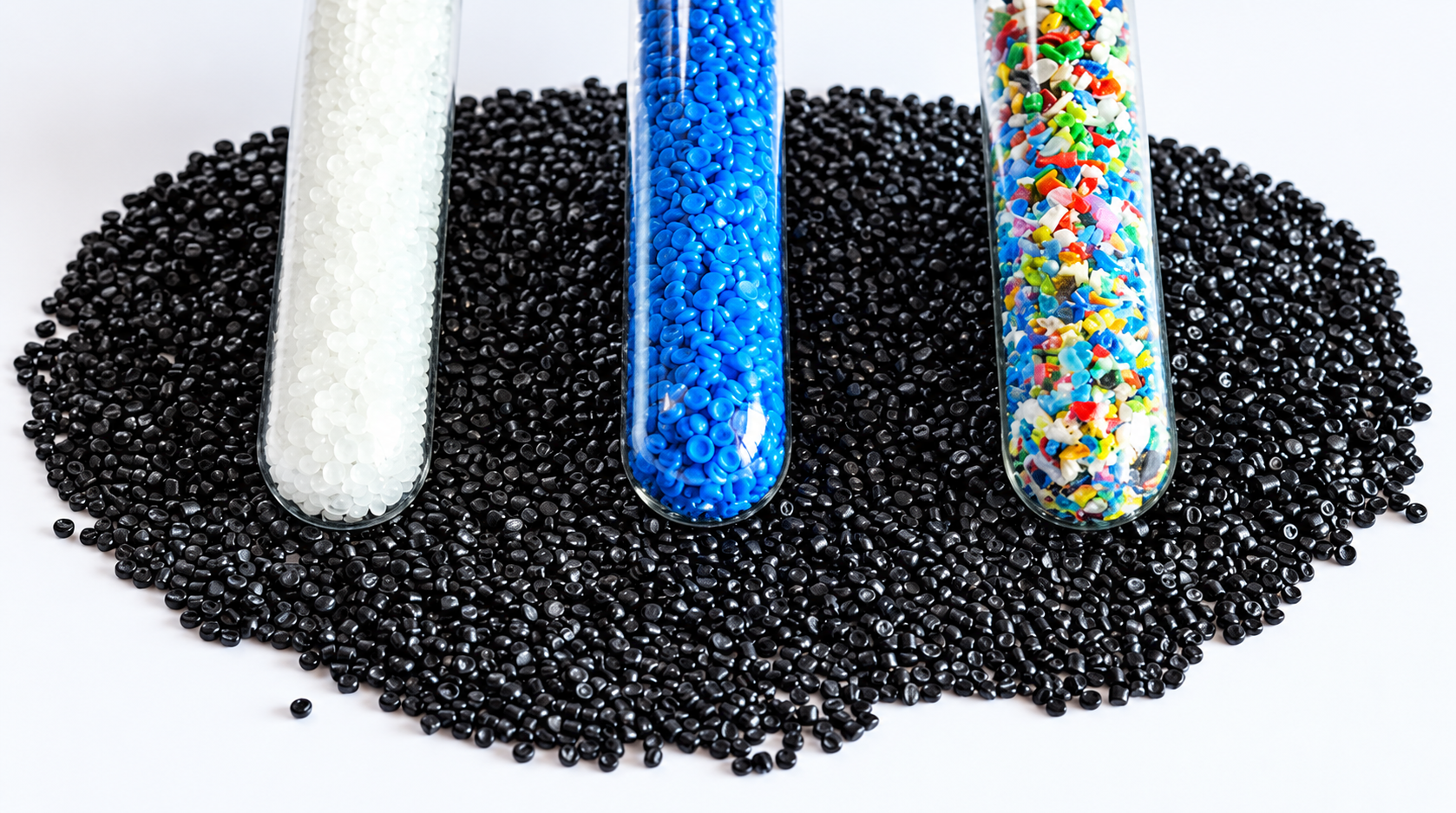
Post-consumer recycled (PCR) resin is produced from plastic that has completed its original lifecycle, collected, sorted, cleaned, and reprocessed into pellets. In contrast, virgin resin is manufactured under tightly controlled conditions with consistent chemistry, molecular weight, and performance characteristics.
PCR materials inherit variability from their previous use and processing history. This leads to several differences that directly affect injection moulding performance:
- Variable Melt Flow Index (MFI), causing unpredictable filling behaviour
- Higher contaminant load, including degraded polymers or foreign particles
- Elevated moisture content, especially in hygroscopic materials
- Greater sensitivity to thermal degradation due to prior heat exposure
Processing PCR is often compared to cooking with a recipe where the ingredient quality changes with every batch. Even when specifications are met, subtle differences in viscosity, stability, or cleanliness can influence how the material flows, cools, shrinks, and ultimately forms the final part.
For mould designers, this means conventional tooling assumptions based on virgin materials may no longer hold. Successful PCR resin injection moulding requires accommodating variability rather than fighting it.
Key Challenges in Designing Moulds for PCR Materials
Designing moulds for PCR-compatible materials introduces a set of engineering challenges that go beyond conventional tooling practice. Based on extensive programme experience, EIPL has documented ten recurring issues that directly affect part quality, cycle stability, and mould life. Understanding these challenges early allows teams to design tooling that absorbs variability rather than being compromised by it.
Material Inconsistency & Variable Melt Flow Index (MFI)
PCR resin rarely delivers the tight viscosity consistency seen with virgin materials. Fluctuating MFI can cause unpredictable filling behaviour, leading to short shots in low-flow conditions and flash or burn marks when flow spikes. This is particularly problematic in multi-cavity tools where balance is critical. EIPL designs gates and runner systems to accommodate an MFI range, not a single value, ensuring stable cavity filling across batches.
Contamination, Impurities & Accelerated Tool Wear
Recycled streams often contain residual contaminants such as degraded polymer fragments, paper fibres, aluminium traces, or fillers. These particles can clog hot runner systems, damage valve gates, and accelerate wear on cavity surfaces. Over time, this shortens tool life and increases maintenance frequency. EIPL mitigates this risk through nozzle filtration, inline magnetic traps, and the use of abrasion-resistant steel grades and coatings.
Thermal Degradation: Yellowing, Brittleness & Weld Line Weakness
PCR materials typically have lower thermal stability because they have already undergone prior processing cycles. Excess heat or long residence times can further degrade polymer chains, causing discolouration, brittle parts, and weak weld lines. In production, this appears as yellowing, cracking under load, or premature failure. Process strategies such as reduced barrel temperatures and minimised residence time are essential to preserve material integrity.
Aesthetic Variability: Colour Shifts & Surface Defects
For packaging and consumer-facing products, appearance consistency is critical. PCR resins often exhibit colour variation between batches due to mixed feedstock and degradation history. Contaminants can also create surface specks, flow marks, or dull finishes. EIPL applies rigorous material qualification and visual approval processes for aesthetic-sensitive programmes to ensure acceptable consistency before full production.
Cooling Non-Uniformity & Dimensional Instability
Variable crystallisation behaviour in recycled polymers can lead to uneven shrinkage during cooling. This increases the risk of warpage, dimensional drift, and inconsistent wall thickness. Traditional cooling layouts may not deliver the uniform heat removal needed for stable parts. Engineering solutions such as optimised cooling layouts or conformal cooling help deliver flat parts, predictable dimensions, and consistent cycle times.
Odour Release & Brand Experience Impact
Some PCR materials release residual odours originating from their previous applications or degradation products. While not always a structural issue, this can significantly affect perceived product quality in premium consumer goods. Poor venting can trap volatile compounds inside the moulded part. Advanced venting design and careful material selection help minimise odour transfer and protect brand experience.
EIPL’s Engineering Adaptations for PCR-Compatible Mould Design
At EIPL, we treat PCR-compatible mould design as a fundamentally different engineering problem, not a minor variation of virgin-material tooling. Over time, we have developed a practical playbook built around real production data, not theory. The guiding principle is simple: design the tool to absorb material variability, rather than expecting the material to behave predictably.
Below are the core engineering levers we adjust and the reasons behind each change.
Gate Optimisation: Valve Gates & Larger Gate Geometries
Standard gate designs are typically optimized for consistent, lower-viscosity virgin resins. PCR materials often exhibit higher and more variable viscosity, making conventional gates prone to freeze-off, excessive shear heating, or incomplete filling.
At EIPL, we frequently deploy valve gate systems to achieve precise control over the velocity-to-pressure (V/P) transition and cavity fill balance. Larger gate geometries are used to reduce shear stress and improve flow stability across batches. For high-wear applications, replaceable gate inserts are incorporated so that maintenance can be performed without reworking the entire mould, preserving long-term tooling integrity.
Steel Selection: H13, P20+Ni & Surface Coatings
PCR resins introduce abrasive contaminants that standard mould steels are not designed to withstand over extended production cycles. Conventional P20 steel, while cost-effective, can suffer accelerated wear, pitting, and surface degradation.
We therefore select tougher base materials such as H13 or nickel-enhanced P20 variants for improved hardness and corrosion resistance. Where operating conditions demand additional protection, surface coatings such as TiN or DLC are applied to critical inserts. These coatings reduce friction, resist abrasion, and significantly extend service intervals, lowering total cost of ownership.
Conformal Cooling for Thermal Uniformity
PCR materials can crystallise and shrink unpredictably, making uniform cooling essential for dimensional stability. Traditional straight-drilled cooling channels often leave hot spots, leading to warpage, sink, or cycle variability.
Conformal cooling addresses this by routing cooling channels to closely follow the geometry of the cavity. In simple terms, heat is removed evenly from all critical areas instead of only where drilling allows. At EIPL, we use additively manufactured inserts built via SLM/AM processes when geometry requires it. The result is more uniform crystallisation, flatter parts, improved dimensional consistency, and often shorter cycle times.
Advanced Venting Strategies
Recycled materials typically release more volatiles and trapped gases during processing due to residual contaminants and prior degradation. Inadequate venting can cause burn marks, incomplete filling, surface defects, and persistent odour issues.
Our venting approach considers vent depth, land width, and placement relative to flow fronts. For complex geometries, we may incorporate porous vent inserts or vacuum-assisted venting to actively remove trapped gases. The outcome is cleaner surfaces, fewer cosmetic defects, and improved sensory quality for consumer-facing products.
Scientific Injection Moulding Principles for PCR
Processing PCR successfully requires a disciplined, data-driven approach rather than rule-of-thumb settings. Fill balancing, accurate V/P switchover, and controlled cooling profiles become critical because the material window is narrower and less forgiving.
At EIPL, we apply scientific moulding principles supported by structured DOE studies tailored specifically to PCR grades. We document these process windows rigorously and treat them as material-specific, not transferable from virgin resin programs. This ensures stable production, consistent part quality, and faster troubleshooting when feedstock variability occurs.
Conclusion
PCR adoption is reshaping modern manufacturing, and successful implementation now depends as much on tooling strategy as on material selection. Designing moulds for PCR-compatible materials requires manufacturers to address variability in melt flow, contamination, thermal stability, cooling behavior, and long-term mould wear from the very beginning of the engineering process.
As sustainability mandates continue to accelerate, conventional tooling approaches are no longer enough for reliable PCR resin injection moulding. Companies that invest in PCR-compatible mould design, scientific moulding principles, advanced cooling strategies, and robust process control will be better positioned to achieve both sustainability targets and production stability.
At Efficient Innovations, we help manufacturers turn PCR processing challenges into scalable engineering solutions, enabling consistent quality, longer tool life, and more reliable high-volume production with recycled materials.
Frequently Asked Questions About PCR Mould Design
What makes PCR materials harder to mould than virgin resins?
PCR resins vary in melt flow, contamination level, moisture content, and thermal stability from batch to batch. This inconsistency affects fill behaviour, aesthetics, and mechanical properties, requiring wider process windows, robust tooling, and stricter material control compared to uniform virgin resins.
What steel grades should I use for moulds running PCR materials?
Abrasion-resistant steels such as H13, hardened P20+Ni, or tool steels with protective coatings (e.g., TiN, DLC) are preferred. PCR contaminants accelerate wear, so higher hardness, corrosion resistance, and surface protection significantly extend tool life.
How does conformal cooling help with PCR mould design?
Conformal cooling maintains uniform temperature across complex geometries, compensating for PCR’s variable crystallisation behaviour. This reduces warpage, shrink variation, and cycle time while improving dimensional stability and part consistency.
Can I use the same process settings for PCR as for virgin resin?
No. PCR typically requires adjusted temperatures, pressures, screw speeds, and residence times due to lower thermal tolerance and variable viscosity. Settings must be validated through material-specific trials or DOE rather than copied from virgin resin processes.
What causes odour issues with PCR resins, and how can they be managed?
Residual contaminants, degraded polymers, and trapped volatiles generate odours during processing. Effective venting, controlled temperatures, proper drying, and sourcing higher-quality PCR grades help reduce odour impact on finished products.